

The Mother Goose on the Loose Blog

Importance of Developing THE WHOLE CHILD

Share

This week, I’ve read a few articles on the importance of play, of play as being the work of childhood, and on the misguided common core standards. In Reading Instruction in Kindergarten: Little to Gain and Much to Lose, Common Core standards that expect children in Kindergarten to be naming letters and writing words and sentences is  compared to research-proven timetables for children’s development. The results show that the strong emphasis on teaching children to read before first grade can be detrimental rather than helpful to their developing reading skills (https://deyproject.files.wordpress.com/2015/01/readinginkindergarten_online-1.pdf).

In another article, “Linking self-regulation, pretend play and learning in young children,” Marcy Guddemi, PhD cites studies showing that children who attended play-based preschools with more time given for exploring the world and playing with peers ended up doing better academically in school. These studies also linked the development of self-regulation and executive function skills in the early years of life as being stronger factors contributing to success in school that the ability to read at an early age. (http://seenmagazine.us/articles/article-detail/articleid/3237/important-new-findings.aspx)

One last report, “Lively Minds: Distinctions between academic versus intellectual goals for young children” by Lillian G. Katz, PhD at the University of Illinois states that ” intellectual dispositions may be weakened or even damaged by excessive and premature formal instruction,… they are also not likely to be strengthened by many of the mindless, trivial if not banal activities frequently offered in child care, preschool and kindergarten programs. ” She continues:  “the common sense notion that “earlier is better” is not supported by longitudinal studies of the effects of different kinds of preschool curriculum models…..when young children engage in projects in which they conduct investigations of significant objects and events around them, for which they have developed the research questions and by which they themselves find out how things work, what things are made of, what people around them do to contribute to their well-being, and so forth… their lively minds are fully engaged.” She concludes that ” depending on the extent and intensity of it, introduction of formal academic instruction in the preschool years may not be in the best interests of many of our children, and in fact, may be damaging to some of them in the long term….[E]arly childhood curriculum and teaching methods are likely to be best when they address children’s lively minds so that they are quite frequently fully intellectually engaged.” (https://deyproject.files.wordpress.com/2015/04/dey-lively-minds-4-8-15.pdf)

It is amazing that while evidence in support of the development of the WHOLE CHILD, with social, emotional and cognitive development going hand-in-hand, that many preschools and kindergartens throughout the US are spending less time on play and more energy on doing assessments based on a list of skills that may not even be developmentally appropriate.
Tools of the Mind and the Civil War Museum

Share

In the Mother Goose on the Loose April newsletter, I mentioned attending a conference for the Society for Research in Child Development and listening to Dr. Clancy Blair talk about his research on “Tools of the Mind.” Shortly after sending out the newsletter, I received the following email from a colleague and obtained her permission to reprint it below:

I read about your chat with Clancy Blair in the newsletter. My sons attended a “Tools of the Mind” preschool here in MA. I have “borrowed” so many Tools ideas for my storytimes and other programs. It is a great curriculum and educational theory that can really help support much of what we do in library programs for children. I especially love their games that help with executive functioning skills like impulse control. My sons’ preschool is our town’s inclusive special ed school, and having both a typically developing and a developmentally disabled child, I saw first hand how Tools of the Mind can scaffold kids at every stage and ability. I’m so glad you got the chance to attend that conference and learn about the research being done. -Ashley

The newsletter just started in January due to the urging of my Workshop Outreach Coordinator (who is also my son, Alon). It is a pleasure to see that it is being read and inspiring others to comment. I love hearing from my colleagues!  Please, keep your comments coming!

I am now on a whirlwind tour of Pennsylvania presenting “Nurturing the Brain through Storytime” for the Pennsylvania Department of Education.  Pennsylvania has Early Learning Standards that fit perfectly into Every Child Ready To Read’s “Talk, Sing, Read, Write and Play” practices.  They also emphasize that the youngest children learn through play, and that healthy development in the earliest years should include social, emotional, and cognitive development. This fits in perfectly the MGOL concept of the WHOLE child.

Today, Alon and I are at the Civil War Museum in Harrisburg, PA.  On behalf of Pennsylvania OneBook, I will be presenting to childcare providers, museum professionals, children’s librarians, early literacy personnel, teachers, university professors and teachers. We arrived early and I took the opportunity to peruse the exhibits. And now, it’s time to stop writing and listen to a presentation by author/illustrator Lindsay Barrett-George.

Busy March finished, busy April coming up

Share

In March I attended my first SRCD (Society for Research in Child Development) conference. It was very different from the typical library conferences I have attended.  One of the coolest things was meeting (in person) some of the people whose research I have read and whose names I have been citing in my bibliographies for years.  Some of my favorite researchers were there including Clancy Blair, Adele Diamond, Roberta Golinkoff, Kathy Hirsh-Pasek, and Allison Gopnik.  If you’d like to read more about the SRCD conference, have a look at the most recent MGOL monthly newsletter at http://us9.campaign-archive1.com/?u=df06df4c99dd5cf4c9aafe975&id=4878f5a79d

While trying to expand examples of  nursery rhymes for use in library programs, I have asked readers to send in links to any library websites that contain videos of librarians reciting fingerplays or rhymes.  We just sent out the newsletter this morning, and have already received six!

Toward the end of March, I presented a MGOL workshop in East Hartford, Connecticut. After being rescheduled because of the enormous snowstorms, we finally met to have a fun day together in a wonderful building in a room with a working fireplace. Librarians were in the minority there; most of the attendees were people from the East Hartford area who work with early literacy such as home visitors and childcare resource center staff.

In April, I’ll be presenting a MGOL program at a Baltimore City Public School followed by a mini workshop for Baltimore City School Librarians. For two weeks, I will be traveling throughout Pennsylvania presenting “Nurturing the Brain through Storytime” workshops for the Pennsylvania One Book Professional Development Day 2015. Then, it is off to Ocean City to present a session for the Maryland State Child Care Association Conference.

In between all of this, there will be our family celebration of Passover, work on a grant, a new book, and writing the newsletter for May! Plus, the MGOL office has expanded going from one small room upstairs to our entire downstairs family room. It’s time to go through files and organize materials, plus weeding the collection of books and papers I have accumulated throughout the years.

I feel lucky to be so busy doing work that I am passionate about.

Have a wonderful month, everyone.

Ready and Waiting for You – A book about entering kindergarten

Share

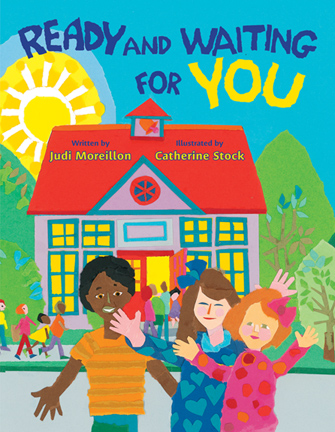
ReadyAndWaitingForYou_Cover_Web_sizedYesterday, I had the pleasure of reading a book by Judi Moreillon.  Ready and Waiting for You (illustrated by Catherine Stock) is much more than the average “prepare for kindergarten” book. The loving tone and multi-cultural characters in this book distinguishes it from all the others. A repeated lyrical phrase invites children to kindergarten: “Come in. Come in. Come in through this door. Are you new?” The pages with door illustrations have flaps that open out, leading into different school related spaces: a yellow bus, the school entrance, the library, cafeteria, and classroom. In each setting, brightly colored collage characters complete the phrase with, “We’re ready and waiting for you.”

 Some sophisticated vocabulary words (i.e. “your boisterous bus mates”) blend in easily with the rhymes. Characters come in all shapes, sizes, and colors. The detailed illustrations can be used as starting points for conversations. This book was listed as one of Bank Street College’s 2014 Best Books, recommended for children ages 4-6. Have a look at the book trailer, http://tinyurl.com/btrandw4u, and see for yourself how wonderful this book is!


(Judy’s blog address is: http://storytrail.com/Author/books.html)

You have a great idea! Now get it published! (Webinar alert!)

Share

Julie Dietzel-Glair, Kathy MacMillan and I have prepared a webinar for the Maryland Library Association. We were supposed to present it last week, but due to the snow, the webinar has been rescheduled to Thursday, March 5, from 2-3 pm.

You Have a Great Idea! Now Get it Published!

Do you want to write a book or article but don’t know where to start? In this 1-hour webinar, three published authors of resource books and articles for children’s librarians will share the ins and outs of getting published in journals such as School Library Journal and with publishers such as ALA Editions and Libraries Unlimited. Learn about the publishing opportunities that are out there for you, what you’ll need to include in your proposal, and how to get from idea to proposal. Join us and jumpstart your publishing career!

Platform: Blackboard

Registration Information:  http://www.mdlib.org/calendar_day.asp?date=3/5/2015&event=48

MLA members $15, non members $23, students $13

1 contact hour awarded